
WELCOME TO JOMO'S Sculptures
The Great American Peekshow
An Essay of explaining - by Joachim St. Maximilian
'The Great American Peekshow' by JOMO works dynamically as both an object and an experience. At first glance, the sculpture presents itself with the playful visual language of roadside attractions and carnival curiosities. One thinks with more mature intentions upon the initial view. The hand-painted lettering, slightly imperfect and intimate, reads: “Come see the Main Event.” It evokes the nostalgic charm of Americana—the promise of spectacle, titillation, and a harmless moment of curiosity. Yet this invitation is immediately destabilized when the viewer recognizes the structure itself: a small, tunnel-like chamber reminiscent of the voyeuristic booths of old peep shows. The work lures the viewer into participation, implicating them in the very critique it unfolds. You must physically lean in, narrowing your field of vision, to see what lies inside. In doing so, you adopt the posture of the voyeur—the citizen peering into the machinery of their own seduction.
Inside the chamber, the work’s psychological architecture becomes clear. Rather than erotic imagery—the expected currency of a traditional peep show—the viewer encounters a mousetrap. This substitution is devastatingly precise. The mousetrap is not simply a symbol of danger; it is a metaphor for systemic entrapment disguised as reward. A folded dollar bill sits as bait, positioned exactly where the mechanism will snap. Here, JOMO reveals the underlying thesis of the sculpture: American pleasure culture is structured precisely like a trap. The promise of wealth, status, and technological progress becomes the bait that encourages citizens to place themselves willingly within systems designed to capture their attention, labor, and loyalty- while destroying empathy and social reasoning.
The interior environment reinforces this psychological tension. The walls are dark, almost theatrical, covered with handwritten exclamations—“Ha ha!”, “Gotcha!”, “Dumbass!”—phrases that echo like taunts from an unseen spectator. These words shift the emotional tone of the piece from curiosity to humiliation. They suggest that the trap is not merely mechanical; it is performative. Someone—or something—is laughing. The viewer realizes that the spectacle is not the mousetrap itself, but the citizen caught in it. The peep show format becomes inverted: instead of the viewer watching a performer, the system watches the viewer.
Perhaps the most cutting element is the presence of the Tesla logo incorporated into the trap’s bait. In this context, it represents the seductive mythology of technological salvation that pervades modern American culture. Brands like Tesla promise innovation, futurism, and the illusion of participation in progress. Yet within the sculpture, the logo functions as bait—another gleaming symbol that entices the public into a larger apparatus of consumption and ideological loyalty. JOMO’s critique is not simply about one company or figure; it is about the broader phenomenon of charismatic techno-capitalism, where individuals become enthralled by visionary narratives while the structural consequences remain hidden. The sculpture suggests that the citizen is encouraged to admire the machinery even as it tightens around them.
The physical design of the sculpture deepens this commentary. The bright yellow interior resembles a theatrical spotlight or carnival booth lighting—an artificial brightness that contrasts sharply with the dark, conspiratorial back wall. The rope framing the interior suggests both a stage curtain and a boundary, emphasizing that what we are seeing is a performance of national identity. America itself becomes the peep show: a spectacle of promises, pleasures, and distractions that keep the viewer leaning forward while the trap waits patiently beneath the surface.
In this way, The Great American Peekshow functions as a psychological mirror. The viewer approaches it with curiosity, amusement, perhaps even skepticism. But the act of looking becomes the artwork’s central revelation. The sculpture asks: Why did you lean in? What did you think you were going to see? By transforming the viewer into a participant in the trap, JOMO exposes the deeper mechanisms of desire and complicity that operate within consumer society.
Ultimately, the work suggests that the “main event” is not hidden inside the box at all. The real spectacle is the relationship between power, pleasure, and participation in modern America. The trap is visible. The bait is obvious. And yet, like the viewer drawn toward the opening of the sculpture, the nation continues to lean forward—curious, hopeful, and dangerously close to the snap.

The phrase “The Main Event” parallels a central aspect of American society—the prevailing emphasis on capitalism, often framed as an all-or-nothing pursuit.

The attraction sign and title effectively align with the viewer’s natural curiosity. The title alone suggests that the issue it presents is universal—something to which nearly everyone is susceptible, including the creator of the work himself.
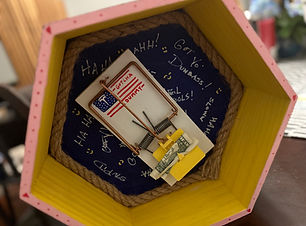
The trap's base is marked with a stylized American flag and the handwritten
taunts that reinforce he sense that the viewer-and by the extension of the citizen-is the intended victim of the setup.